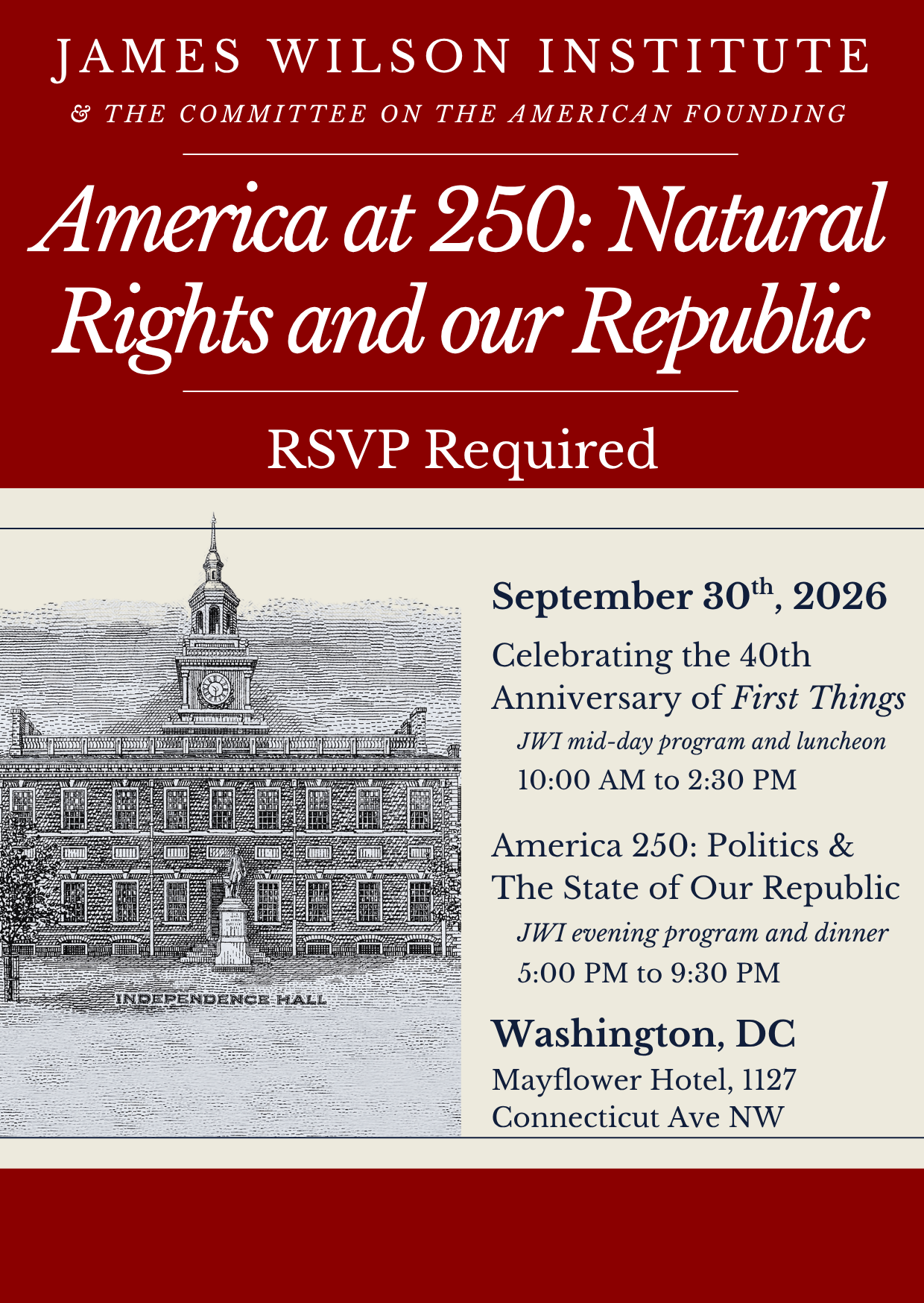
First Things at 40
Luncheon and Anniversary Conference

10:30 AM Panel 1: The Legacy of First Things in Academia and Law
JWI Co-Director Gerry Bradley (moderator), Prof. Francis Beckwith, JWI Senior Fellow Justin Dyer, Prof. Daniel Mahoney, Prof. Robert Miller, Prof. Diana Schaub
11:45 AM Lunch
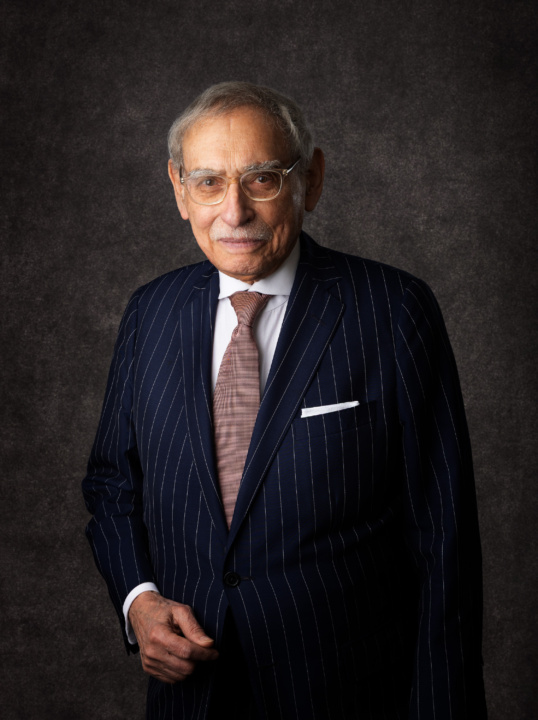
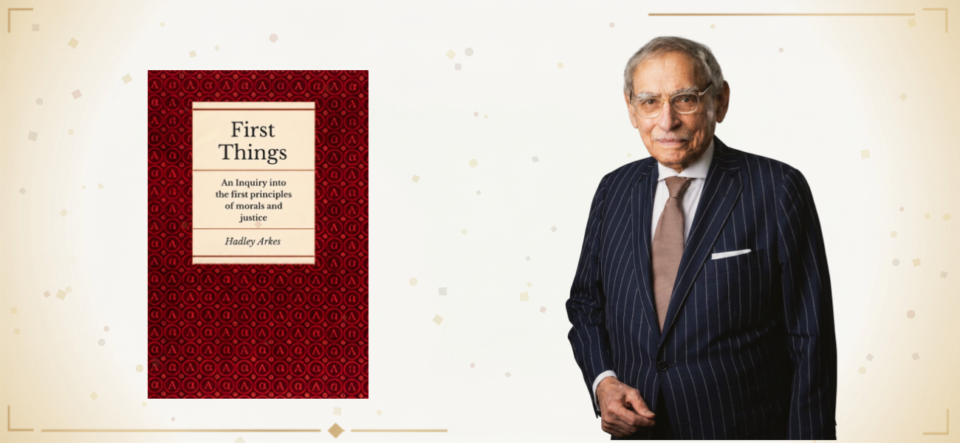
12:15 PM Keynote Remarks from Prof. Hadley Arkes
1:15 PM Panel 2: The Legacy of First Things at Amherst
Garrett Snedeker '09 (moderator), Paul Kapur '90, Susannah Black Roberts '98, Ethan Davis '05, Alexander Vega '16
Dinner
America 250: Politics & the State of Our Republic
5:00 PM to 9:30 PM
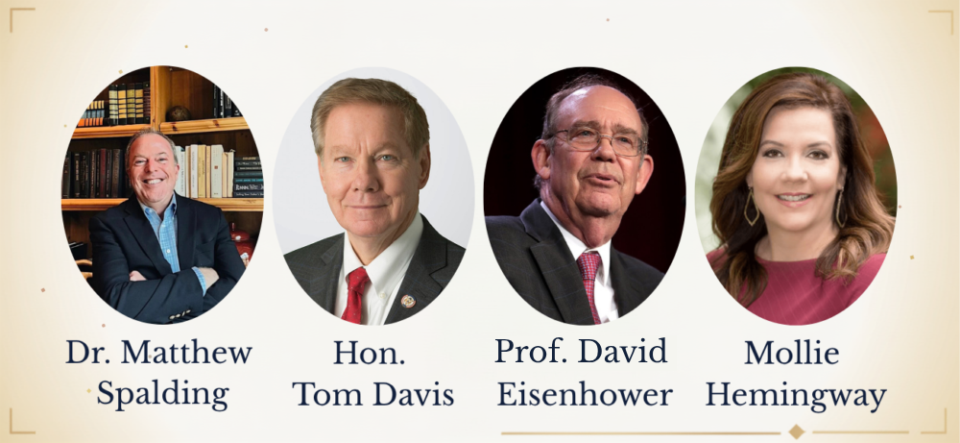
Dinner Panel: Dr. Matthew Spalding (moderator), Hon. Tom Davis '71, Prof. David Eisenhower '70, Mollie Hemingway
Francis J. Beckwith is Professor of Philosophy & Church-State Studies, Affiliate Professor of Political Science, and Associate Director of the Graduate Program in Philosophy at Baylor University, where he is also a Resident Scholar in Baylor’s Institute for Studies of Religion. He is the author of over 100 academic articles, book chapters, and reviews, and over a dozen books including Politics for Christians: Statecraft As Soulcraft (InterVarsity, 2010), Never Doubt Thomas: The Catholic Aquinas as Evangelical and Protestant (Baylor University Press, 2019), Defending Life: A Moral and Legal Case Against Abortion Choice(Cambridge University Press, 2007), and Taking Rites Seriously: Law, Politics, and the Reasonableness of Faith (Cambridge University Press, 2015), winner of the American Academy of Religion’s 2016 Book Award for Excellence in the Study of Religion in the category of Constructive-Reflective Studies. A graduate of Fordham University (Ph.D., philosophy) and the Washington University School of Law in St. Louis (Master of Juridical Studies), he has served as a 2002-2003 Visiting Research Fellow in Princeton University’s James Madison Program, the 2008-2009 Mary Ann Remick Senior Visiting Fellow in the de Nicola Center at the University of Notre Dame, and the 2016-2017 Visiting Professor of Conservative Thought & Policy at the University of Colorado, Boulder.
At Meta Platforms, Ethan Davis holds the title of Vice President, Head of Global Litigation Strategy, a position in which he helps guide the company's approach to litigation and enforcement matters both domestically and internationally. His portfolio also covers defending against investigations launched by Congress, the FTC, DOJ, the SEC, and various state Attorneys General.
Prior to Meta, Davis worked as a white-collar partner at King & Spalding's San Francisco office, representing both corporate and individual clients in civil litigation matters as well as civil and criminal government investigations. Earlier still, he held the position of acting Assistant Attorney General leading the Justice Department's Civil Division, a role that put him in charge of most of the federal government's civil litigation work along with the division's proactive enforcement initiatives.
Davis's clerkship experience includes time with Judge Diarmuid F. O'Scannlain of the Ninth Circuit and Justice Neil Gorsuch of the Supreme Court. He holds degrees from Amherst College and Yale Law School.
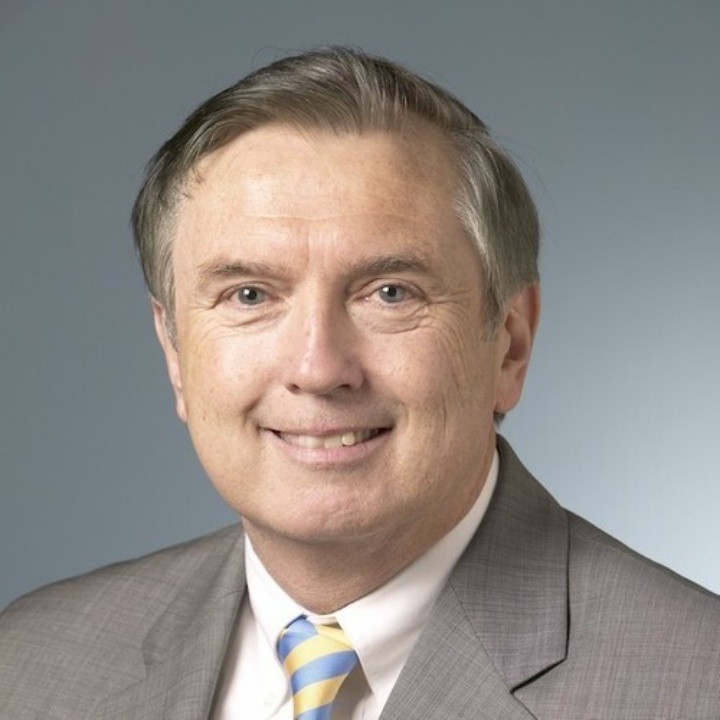
Tom Davis is a former Republican member of the U.S. House of Representatives from Virginia. Over seven terms in office, he sponsored more than 100 pieces of legislation that were ultimately enacted. He also made history as the first first-term member in half a century to chair a subcommittee, leading the Subcommittee on the District of Columbia.
During his time on Capitol Hill, Davis earned a reputation as a shrewd legislator, a trustworthy dealmaker, and a savvy political strategist. Colleagues noted his remarkable command of political detail, and he was known to brief fellow lawmakers on the electoral track record of their own districts. Along with Democratic Congressman Martin Frost of Texas, he co-wrote The Partisan Divide: Congress in Crisis, a book examining potential solutions to Washington's political gridlock.
Justin Dyer is professor of government and the inaugural dean of UT Austin's School of Civic Leadership.
Dyer writes and teaches in the fields of American political thought, jurisprudence and constitutionalism, with an emphasis on the perennial philosophical tradition of natural law. He is the author or editor of eight books and numerous articles, essays and book reviews. His most recent book, with Kody Cooper, is The Classical and Christian Origins of American Politics: Political Theology, Natural Law, and the American Founding, published in 2022 by Cambridge University Press. His previous books with Cambridge University Press include C.S. Lewis on Politics and the Natural Law (2016); Slavery, Abortion, and the Politics of Constitutional Meaning (2013); and Natural Law and the Antislavery Constitutional Tradition (2012). He also is co-editor of the two-volume constitutional law casebook American Constitutional Law (4th edition, West Academic), which has been adopted at leading universities across the country.
Previously, he was a professor of political science at the University of Missouri, where he served as the founding director of the Kinder Institute on Constitutional Democracy, a signature academic center for the study of American political thought and history. After attending the University of Oklahoma on a wrestling scholarship, he completed his M.A. and Ph.D. in Government at The University of Texas at Austin.
Professor Dyer serves on the JWI Board of Scholars.
David Eisenhower directs the Institute for Public Service at the University of Pennsylvania's Annenberg School of Communication. He wrote Eisenhower at War: 1943-1945, a work that was a finalist for the 1987 Pulitzer Prize in history. He studied at Philips Exeter Academy, Amherst College, and George Washington University Law School. His father and mother were John and Barbara Eisenhower, making him the grandson of President Dwight D. Eisenhower. He is married to Julie Nixon Eisenhower, the younger daughter of President Richard Nixon, and the couple—parents to three grown children—make their home in the Philadelphia suburbs.
Mollie Hemingway serves as Editor-in-Chief of The Federalist, holds a position as Senior Journalism Fellow at Hillsdale College, and contributes to Fox News. She has authored three New York Times bestsellers, one of which is Alito: The Justice Who Reshaped the Supreme Court and Restored the Constitution. Her work has been honored with The Bradley Prize, given for exceptional contributions to scholarship and public debate in America, and the Dao Grand Prize for Journalism, which she received for her reporting series on the Russia Collusion Hoax.
S. Paul Kapur was sworn in as Assistant Secretary of State for South and Central Asian Affairs on October 22, 2025. He is on leave from the United States Naval Postgraduate School, where he was a professor in the Department of National Security Affairs. Previously, Kapur was a visiting fellow at the Hoover Institution, served on the State Department’s Policy Planning Staff, and taught at Claremont McKenna College. Kapur is author of Jihad as Grand Strategy: Islamist Militancy, National Security, and the Pakistani State (Oxford University Press); Dangerous Deterrent: Nuclear Weapons Proliferation and Conflict in South Asia (Stanford University Press); co-author of India, Pakistan, and the Bomb: Debating Nuclear Stability in South Asia (Columbia University Press); and co-editor of The Challenges of Nuclear Security: U.S. and Indian Perspectives (Palgrave Macmillan). His work has also appeared in leading academic journals, in popular news outlets, and in a wide variety of edited volumes. Kapur has directed an annual United States-India Track 1.5 strategic dialogue, as well as other U.S.-India engagements, for the Department of Defense. He received his Ph.D. from the University of Chicago and his B.A. from Amherst College.
Daniel J. Mahoney holds the Augustine Chair in Distinguished Scholarship at Assumption College. He received his B.A. from the College of Holy Cross and his M.A. and Ph.D. from Catholic University of America in political science. In 1999, Professor Mahoney was the recipient of the prestigious Prix Raymond Aron. He is associate editor of Perspectives on Political Science and book review editor for Society magazine. A renowned expert on French political philosophy, his books also include the critically acclaimed Aleksandr Solzhenitsyn: The Ascent from Ideology.
Dr. Mahoney serves on the JWI Board of Scholars.
Robert T. Miller holds an Allison and Dorothy Rouse Chair in Law at the Antonin Scalia Law School at George Mason University. An elected member of the American Law Institute and a research member of the European Corporate Governance Institute, Professor Miller is also the Co-Director of the Program on Organizations, Business and Markets at the Classical Liberal Institute at the New York University Law School. Prior to joining the faculty at George Mason in 2025, Professor Miller was the F. Arnold Daum Chair in Corporate Finance and Law at the University of Iowa College of Law.
Professor Miller’s research concerns corporate and securities law, the economic analysis of law, and the philosophy of law. He has written on the fiduciary duties of corporate directors, director oversight liability, the history and development of Delaware corporate law, shareholder governance versus stakeholder governance, corporate social responsibility and the ESG movement, the relation of welfare economics to corporate law, the valuation of businesses in Delaware appraisal proceedings, and other topics related to mergers and acquisitions and other complex commercial transactions. His articles have been cited by federal and state courts in the United States, including the Delaware Supreme Court and the Delaware Court of Chancery, as well as commercial courts in United Kingdom and Canada. In particular, the Delaware courts have cited Professor Miller’s articles on material adverse effects, an issue the Court of Chancery has described as “one of the most difficult issues under Delaware law,” more than forty times.
Professor Miller has been a Visiting Professor of Law at the University of Pennsylvania Law School, a Visiting Assistant Professor of Law at the Cardozo Law School, and an Olin Fellow in Law and Economics at the Columbia Law School. Before entering academia, Professor Miller was an associate with Wachtell, Lipton, Rosen & Katz. He earned his J.D. from the Yale Law School, his M.A. and M.Phil. degrees in philosophy from Columbia University (where twice taught Literature Humanities, Columbia College’s course in great books for first-year students), and his B.A. in philosophy and mathematics from Columbia College. He has also published a widely-used English translation of De Ente et Essentia, the most important metaphysical work of Thomas Aquinas.
Douglas Neff is a Co-Founder of IHP Capital Partners and serves as Chairman of IHP’s Investment Committee. Mr. Neff is also the Co-Founder and Chief Executive Officer of Newport Pacific Land Company, an affiliate company of IHP Capital Partners.
From 1985 until the founding of IHP in 1992, Mr. Neff was a Partner of The O’Donnell Group, a major regional developer, owner and manager of commercial and industrial real estate. Previously, he was Treasurer of The Irvine Company, developer of one of the nation’s largest master-planned communities, and a Vice President in the Real Estate Industries Group at Wells Fargo Bank in San Francisco.
A graduate of Amherst College, he received an MBA from the University of Chicago. Mr. Neff is also a member of the Policy Advisory Board of the Fisher Center for Real Estate at the University of California, Berkeley.
Mr. Neff is the Chairman of the Board of Trustees at JWI.
Susannah Black earned her bachelor's degree from Amherst College and her master's from Boston University. She currently serves as an editor for several publications, including Mere Orthodoxy, Plough Quarterly, Postliberal Thought (and its associated journal, New Polity), and The Davenant Press. Earlier in her career, she held editorial roles at Providence and Fare Forward.
She helped found both Solidarity Hall and The Simone Weil Center, and she serves on the boards of the Distributist Review, The Davenant Institute, and The Simone Weil Center.
Her work has been published in a wide range of outlets, among them First Things, The Distributist Review, Solidarity Hall, Providence, Amherst Magazine, Front Porch Republic, Ethika Politika, The Human Life Review, The American Conservative, Mere Orthodoxy, Fare Forward, and Postliberal Thought, as well as other publications.
Diana Schaub holds the position of nonresident senior fellow at the American Enterprise Institute (AEI), focusing her research on American political thought and history—with particular attention to Abraham Lincoln, Frederick Douglass, African American political thought, Montesquieu, and how core American ideals bear on today's challenges and debates. She simultaneously holds a professorship in political science at Loyola University Maryland, a position she's held for nearly thirty years.
As an authority in political philosophy, Schaub has given lectures on numerous subjects and taken part in conferences across the country. Her scholarly contributions include chapters in various books touching on Shakespeare, liberal education, women, and religion. She's also authored three books in her own right: His Greatest Speeches: How Lincoln Moved the Nation (St. Martin's Press, 2021); What So Proudly We Hail: The American Soul in Story, Speech, and Song, which she coedited with Amy and Leon Kass (ISI Books, 2011); and Erotic Liberalism: Women and Revolution in Montesquieu's "Persian Letters" (Rowman & Littlefield, 1995). Additionally, her monograph Emancipating the Mind: Lincoln, the Founders, and Scientific Progress (AEI, 2018) grew out of remarks she delivered at the 2018 Walter Berns Constitution Day Lecture.
Her work has also reached popular audiences through publications such as the Baltimore Sun, the Claremont Review of Books, Commentary, and the Wall Street Journal.
Schaub completed her PhD and MA in political science at the University of Chicago, following her undergraduate studies in political science at Kenyon College.
Garrett Snedeker maintains the James Wilson Institute's year-round presence in the Washington, D.C. area. Beginning as JWI's first staff member in 2013, he was both Assistant Director then Deputy Director before becoming Executive Director in 2026. In addition to close collaboration with JWI's Co-Directors on the intellectual focuses of the Institute, he is the main point of contact for all partnership opportunities and media inquiries as well as the producer of Natural Law Moment and the host of the Anchoring Truths Podcast. He is a graduate of the Antonin Scalia Law School at George Mason University, where he served on the George Mason Law Review as Articles Editor. He graduated from Amherst College, as a one-time student of Prof. Arkes, and formerly worked as editor of the congressional research website LegiStorm. His writing has been featured in Newsweek, The Federalist, The American Mind, The American Conservative, Starting Points Journal, The New Digest, and the Online Library of Law & Liberty. He has been quoted in Politico, Roll Call, and the Boston Herald and collaborated on stories for the New York Times, Wall Street Journal, Washington Post, and National Journal.
He is the Executive Director of JWI.
Matthew Spalding is the Kirby Professor in Constitutional Government and Dean of the Van Andel Graduate School of Government at Hillsdale College and oversees the Allan P. Kirby, Jr. Center for Constitutional Studies and Citizenship at Hillsdale’s Washington, D.C. campus. His new book, The Making of the American Mind: The Making of Our Declaration of Independence, was released in December 2025. Spalding is also the best-selling author of We Still Hold These Truths: Rediscovering Our Principles, Reclaiming Our Future and the original executive editor of The Heritage Guide to the Constitution, the first line-by-line analysis of each clause of the U.S. Constitution.
Appointed executive director of the President’s Advisory 1776 Commission, which produced The 1776 Report, he is currently a senior academic advisor for America250 projects. Prior to joining Hillsdale, Spalding was vice president for American Studies at The Heritage Foundation and founding director of its B. Kenneth Simon Center for Principles and Politics.
He is a senior fellow at the Claremont Institute for the Study of Statesmanship and Political Philosophy and serves on the boards of The Steamboat Institute, Faith & Law, the James Wilson Institute, and New College of Florida. He received his BA from Claremont McKenna College and his MA and PhD from the Claremont Graduate School.
Dr. Spalding is on the Board of Trustees at JWI.
Alexander Vega studies ancient Greek and Roman philosophy, with a particular focus on the philosophy of friendship. His interest centers on how friendship and belief intersect in the writings of Augustine of Hippo, the early Christian philosopher. In texts such as On the Usefulness of Belief and On Faith in Invisible Things, Augustine explores what we should believe about our friends and, more broadly, how the beliefs underlying our relationships shape them.
Vega contends that, for Augustine, the amount of evidence we require before trusting in a friend's goodwill should account for the ethical costs of failing to believe in them. He further argues that Augustine ties our belief in someone else's goodwill to our own beliefs about what benefits us—meaning that genuine friendship rests on holding a correct belief about the good. Vega finds Augustine's treatment of these questions compelling both for its bearing on everyday life and for what it can contribute to contemporary discussions on the ethics of belief. His research interests also extend to Cicero and to modern philosophy of language.